


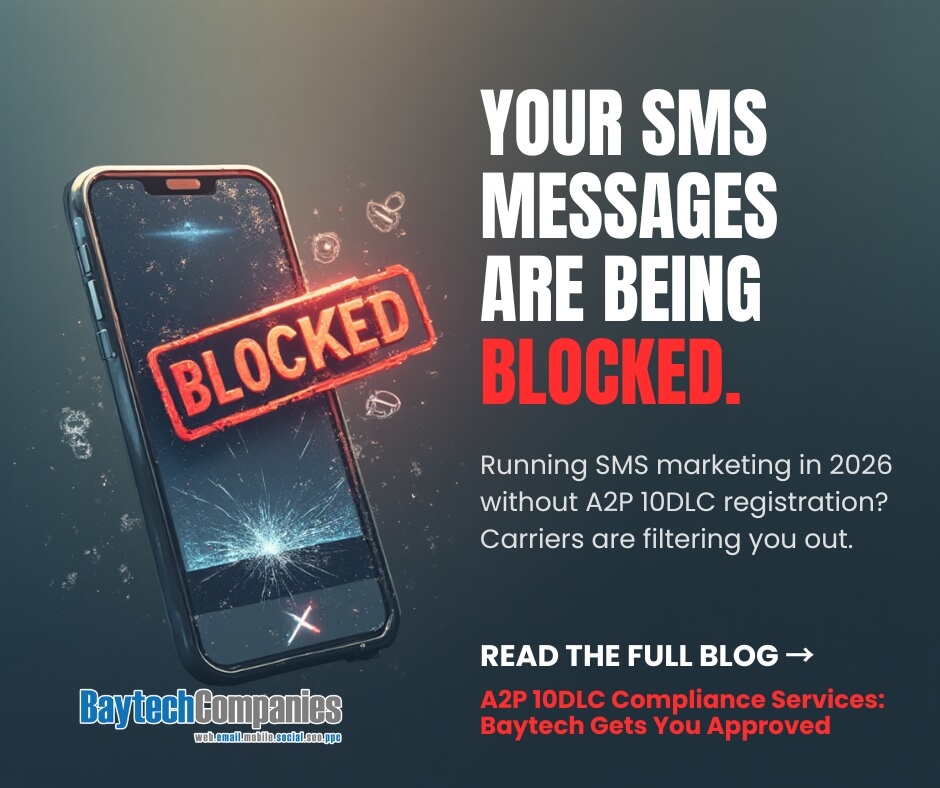
Facebook Post YOUR SMS MESSAGES ARE BEING BLOCKED

If you’re running SMS marketing in 2026 without real A2P registration, you’re not “moving fast.” You’re playing chicken with carrier filtering, spam complaints, and message blocking—and the carriers don’t flinch. That’s exactly why Baytech Companies built out A2P 10DLC compliance services as a core capability for marketing clients who depend on texts to drive appointments, revenue, and retention. The goal is simple: get your brand and campaigns properly registered, align your messaging with current carrier expectations, and keep your outbound SMS landing where it belongs—in front of real customers, not buried in filtering rules you’ll never see.

That being said, what is A2P certification? Why has it become non-negotiable? How does Baytech use BizApp247’s automation stack (built on the GoHighLevel ecosystem) to help clients clear registration, stay compliant, and improve deliverability? Well, faithful one, read on. If your texts are getting filtered, blocked, or throttled—or if you’re about to launch a serious SMS program—this is the difference between traction and a silent failure.

The 2026 Reality: Carriers Treat ‘Unregistered’ Like ‘Untrusted’

Let’s get one thing straight: A2P isn’t a “nice compliance layer.” It’s the permission structure for business messaging on U.S. carrier networks. When you send SMS from an application or system—marketing automation, CRM, scheduling software, follow-up sequences—you’re sending Application-to-Person (A2P) traffic. And 10DLC is the phone-number format most SMBs use: a normal-looking local 10-digit number. Put them together and you get the ecosystem you have to pass through if you want scalable deliverability and throughput.

The carriers built this system because consumers are trained to report junk fast, and that feedback gets used to tighten filters. The FCC is explicit about how consumers can report unwanted texts. According to a February 27 FCC consumer guide, “Most mobile carriers let you block spam by forwarding the message to 7726 (SPAM)—check with your provider.” That matters for businesses because it tells you how quickly a messy SMS program can rack up complaints and get flagged by the same systems you’re trying to reach customers through.

A2P registration is essentially the industry’s way of separating legitimate business messaging from the free-for-all that created the spam problem in the first place. If you want predictable delivery, you need a registered brand, an approved campaign use case, and messaging that behaves like a real business—not like a desperate bot.

What A2P 10DLC Compliance Services Actually Cover

A2P 10DLC compliance services are not “fill out a form and hope.” It’s a combination of identity verification, campaign classification, consent proof, content standards, and operational controls. The goal is to create a message program that carriers can trust and that your customers won’t report as spam.

At the center of the ecosystem is The Campaign Registry (TCR), where brands and campaigns get vetted through carrier-aligned processes. The Campaign Registry itself defines what 10DLC is doing. According to the website, “10DLC is an A2P messaging channel in which Brands and Campaign Service Providers (CSPs) are verified prior to being allowed to send messages.” That one sentence explains the whole game: verification first, messaging privileges second.

So when Baytech provides A2P 10DLC compliance services, the service isn’t “SMS marketing.” It’s making sure your SMS marketing is allowed to function at scale.

Why SMBs Get Wrecked by A2P When They ‘DIY it’

Most SMBs don’t fail A2P because they’re trying to be shady. They fail because they’re sloppy, rushed, or misinformed. They copy a generic disclaimer, slap a “Reply STOP to unsubscribe” line into a template, and assume they’ve done enough. Then the campaign gets rejected, or worse, gets approved but underperforms because consent practices are weak, message samples don’t match the use case, or opt-out handling is inconsistent across numbers and segments.

The real killer is that SMS is one of the few channels where consequences show up immediately. If you annoy people, they report you. If they report you, carriers tighten filtering. If filtering tightens, your messages stop arriving. You can’t “optimize creative” out of that problem. You have to fix the underlying compliance and trust signals.

And consumers are explicitly encouraged to report. The FTC has long advised users to forward spam texts to 7726. According to an FTC guide, “Copy the message and forward it to 7726 (SPAM). This helps your wireless provider spot and block similar messages in the future.” If you run SMS like a blunt instrument, your customers become the enforcement mechanism.

A2P Brand Registration and Campaign Setup: What Carriers Actually Want

A2P brand registration and campaign setup are the backbone of compliance. You’re essentially telling the ecosystem who you are, what you intend to send, and why recipients should expect it. This isn’t philosophical. It’s operational.

Brand registration typically involves your legal business identity, tax information, contact details, and business website. Campaign setup typically involves selecting the correct use case, providing message samples, and demonstrating opt-in, opt-out, and help flows that match what you’ll actually send. If those pieces don’t align, approvals get delayed, rejected, or restricted.

Here’s what Baytech does differently than the average “we can help” vendor: Baytech treats A2P as part of your marketing infrastructure, not a one-time hurdle. That means your messaging program gets designed around consent capture, disclosure clarity, and consistent workflows inside BizApp247—so what you submit is what you run. That eliminates the mismatch that gets campaigns bounced.

The Hard Truth: Deliverability is Earned, Not Assumed

A2P 10DLC certification for SMS marketing is about more than approval. It’s about ongoing deliverability performance. Carriers don’t just ask, “Are you registered?” They watch how recipients respond. High opt-out rates, complaints, and weird sending patterns can trigger filtering even if you’re technically compliant.

This is why Baytech doesn’t treat registration as the finish line. A properly built program includes pacing, segmentation, content discipline, and consistent opt-out handling. It also includes message quality. If your texts read like spam, customers treat them like spam, and the carriers will eventually agree with them.

Baytech’s approach uses BizApp247 to enforce behavioral consistency: how quickly follow-ups occur, how messages are sequenced, and how opt-outs are honored across the database. That operational discipline is what protects deliverability over time.

Ready to Get Started Now? Baytech Can Help!


 

The GoHighLevel Layer: Why Platforms Matter, Without Quoting Platform Marketing

So, how does Baytech leverage the underlying API ecosystem of GoHighLevel? 

GoHighLevel is widely used in SMB marketing automation because it consolidates CRM functions, messaging, automation, pipeline management, and funnel building into one environment. That consolidation matters for A2P because compliance lives in the workflows: where consent is stored, how opt-outs are applied, how message templates are controlled, and how phone numbers are assigned and used.

Baytech leverages BizApp247 (built on that ecosystem) because it gives Baytech a controllable environment to implement compliant messaging patterns at scale. It’s not just “send texts.” It’s: store consent properly, segment responsibly, include required disclosures, maintain opt-out handling, standardize templates, and instrument follow-up sequences so the brand’s behavior stays consistent across campaigns and channels.

The APIs inside the GoHighLevel ecosystem are what let Baytech integrate additional systems—ad platforms, booking calendars, call tracking, and lead sources—so SMS follow-up is triggered by actual customer events rather than random blasts. When your message program is event-driven and consistent, carriers see a legitimate business pattern instead of erratic traffic.

How Baytech Runs A2P Certification Like a Professional Process

Baytech’s A2P process is built for one outcome: approval plus performance. A2P isn’t just a form submission; it’s a compliance buildout that touches legal identity, marketing intent, database hygiene, and operational messaging behavior.

First, Baytech cleans up the identity layer: legal entity details, websites, and messaging disclosures so the brand can pass verification. Then Baytech maps the real use cases for messaging—marketing, customer care, reminders, notifications—so campaign selection matches actual behavior. Then Baytech writes message samples that align with the campaign use case and designs opt-in and opt-out flows that are consistent across channels.

The difference is that Baytech doesn’t leave it as paper compliance. Baytech uses BizApp247 to implement the behavior: how leads enter the system, what messages go out, when they go out, what happens when someone replies STOP, and how that status propagates so the brand doesn’t accidentally text opt-outs later. That’s where many brands get burned—because the human process and the system process don’t match.

Consent: The part everyone wants to gloss over (and carriers won’t let you)

If your opt-in is vague, your SMS program is fragile. It doesn’t matter how clever your campaigns are. Consent is what separates customer communication from nuisance messaging.

Baytech addresses consent in practical terms: your website forms need clear language, your disclosures need to match what you send, and your records need to be retrievable. If a campaign gets questioned or flagged, being able to demonstrate consent and messaging purpose is the difference between correction and shutdown.

And consumers are trained to report. The FCC and FTC both instruct people how to do it. That’s why Baytech’s A2P services emphasize fewer, better messages, sent to people who actually asked for them, in sequences that respect expectations.

Objection: ‘Do We Really Need This if We’re Not Doing Heavy SMS?’

If you’re sending business texts—appointment reminders, follow-up messages, review requests, promotions—you’re in A2P territory. The question isn’t whether you “do heavy SMS.” The question is whether your texts need to land reliably.

In 2026, SMS isn’t just a marketing channel. It’s a customer experience channel. A missed appointment reminder isn’t “marketing.” It’s a service failure. If your texts don’t deliver, customers don’t show. If customers don’t show, you lose revenue. That’s why A2P is not a checkbox. It’s a business function.

Baytech’s A2P 10DLC compliance services exist because SMS is too valuable to run on hope.

Objection: ‘We’ll Just Switch to Email if SMS Gets Harder.’

Email is important. It’s also slower, easier to ignore, and less immediate in high-intent moments. SMS is where urgency and responsiveness live. If you’re relying on SMS for conversions or appointment adherence, switching channels is not a replacement for fixing compliance. It’s a retreat.

The smarter play is to run SMS correctly—registered, consent-based, automated, measurable—so it stays a reliable revenue lever. That’s exactly what Baytech builds.

The ‘Stuck in the Mud’ Scenario: What Happens When You Ignore A2P

When brands ignore A2P, the failure is usually silent. You don’t get a big error message that says “your campaign is blocked.” You just see a drop: fewer replies, fewer conversions, fewer show-ups, fewer sales. Your team blames the offer. The offer blames the market. The market blames the economy. Meanwhile, your deliverability is getting filtered and you’re paying for campaigns that can’t reach customers reliably.

The reason the “silent failure” hurts so much is that you’re not the one in control of delivery anymore—carriers are, and they’re not obligated to give you a friendly heads-up when your program starts looking suspicious. That’s why ignoring A2P feels like you’re driving fine right up until the engine quietly cuts out: the filters tighten, throughput drops, and your messages start disappearing into carrier logic while your team keeps spending like nothing changed. And the industry has been blunt about who holds the power here. According to a Dec. 12 Reuters article, FCC Commissioner Jessica Rosenworcel said the vote means “you no longer have the final say on where your text messages go,” adding, “That means your carrier now has the legal right to block your text messages and censor the very content of your messages.” 

That’s why A2P is imperative in 2026. It’s the difference between “SMS works” and “SMS is a cost center that’s mysteriously underperforming.”

Baytech solves that by designing your messaging program as a compliance-ready system: brand registration, campaign setup, consent hygiene, content discipline, and automation that behaves consistently across your customer journey.

Baytech’s E-E-A-T Advantage: Experience Plus Systems, Not Theory

What makes Baytech credible here isn’t just knowing the terminology. It’s that Baytech has been building marketing infrastructure for years—campaigns, CRM workflows, automation systems—and A2P is now part of that infrastructure.

Baytech’s A2P brand registration and campaign setup process is grounded in what actually happens inside SMB operations: leads come in from multiple sources, staff are busy, follow-up is inconsistent, and systems are fragmented. Baytech’s solution is to unify the behavior through BizApp247 and enforce compliance at the workflow level so the brand behaves consistently.

Baytech’s edge is that the “systems” part isn’t hand-wavy—it’s operational, documented, and built to survive changing carrier requirements without your team scrambling every time the rules tighten. A2P approvals don’t just hinge on what you say you’ll do; they hinge on whether your real-world setup can prove legitimacy, consent, and customer protections at scale, across every number and every workflow. That’s why Baytech treats A2P as infrastructure: the disclosures on your site, the opt-in capture, the opt-out propagation, the message templates, the sending patterns, and the audit trail all have to line up inside the platform so your program can keep running when requirements evolve. And they do evolve. According to an April 6 Twilio changelog, “Starting June 30, 2026, PrivacyPolicyUrl and TermsAndConditionsUrl will be required fields when registering a new A2P 10DLC campaign via the Twilio Messaging REST API.” The takeaway is simple: the bar keeps moving, and “we’ll figure it out later” is how messaging programs get delayed, rejected, or throttled—right when you need them to produce.

That’s the difference between “we can help you register” and “we can help your messaging program survive and scale.”

What ‘Done Right’ Looks Like in 2026

A2P 10DLC compliance services done right produce three things. First, approvals that stick: brand verification and campaign registrations aligned with actual usage. Second, deliverability that holds: a low-complaint, low-opt-out messaging program that carriers don’t have reason to filter. Third, measurable ROI: messaging tied to pipeline events so the business can see what SMS is doing for revenue.

“Done right” in 2026 also means your compliance isn’t trapped in someone’s head or buried in a vendor ticket—it’s provable. Carriers and review processes increasingly reward brands that can demonstrate consent integrity, not just claim it, and that requires disciplined recordkeeping: when and how the opt-in happened, what the exact language was, what campaign it applied to, and whether opt-outs are honored everywhere the customer might reply STOP. That’s the difference between a program that scales smoothly and one that gets slowed down by rejections, audits, or deliverability decay the moment volume increases. According to a February 28 VeraSafe article, “The CTIA’s Messaging Principles and Best Practices require maintaining timestamped records of consent acquisition, its medium (e.g., a web form, SMS opt-in, or paper form), technical data such as the IP address used to grant consent (where applicable), the consumer’s phone number for which consent was granted, the consumer’s identity, the exact consent language, and the specific text message campaign for which the opt-in was provided.” That level of evidence is what separates “we registered” from “we can keep sending without surprises.”

Baytech’s process is built to deliver those outcomes, not just check boxes. Baytech treats A2P as a living component of the growth system, not a one-time submission.

A2P is the New Baseline for SMS Success

In 2026, brands that treat A2P as optional will get stuck in the mud—campaigns blocked, deliverability degraded, and customer communication disrupted. Brands that treat A2P as infrastructure will keep moving: messages delivered, leads worked, appointments booked, and revenue tracked.

Baytech Companies provides A2P 10DLC compliance services because SMS is too powerful to leave to DIY paperwork and crossed fingers. With BizApp247 and a systems-first approach, Baytech helps marketing clients get registered, stay compliant, and actually use SMS as a reliable growth channel instead of a liability.

If your text program matters to your business, A2P 10DLC compliance services aren’t a side project. They’re the foundation. Visit Baytech Companies today to learn more about how they can help your SMB with A2P Certification that will transform your digital marketing efforts. Visit BizApp247 to take the first step toward dominating your market and ensuring your business thrives. Call us today at 888-374-0555 or contact Baytech here.

Breck HapnerAuthor posts

Avatar for Breck Hapner

Breck Hapner is the Managing Editor and Digital Content Director at Baytech Companies, a results-driven digital marketing agency based in Columbus, Ohio. Breck leads content initiatives that drive visibility, engagement, and growth for clients across a variety of industries.

Comments are disabled.